Showing posts with label James Carroll. Show all posts

Friday, July 1, 2022

Ancient Giants of Nevada: Lesser Known But Documented Cases


A special thanks to Dennis Guern and James Carroll for the joint research and giving their feedback on this interesting and detailed article about giant finds in the ancient Lake Lahontan/Nevada region. 

Sunday, February 6, 2022

Forgotten Accounts of Ancient Giants in Nevada


A special thanks to Dennis Guern and James Carroll for the joint research and giving their feedback on this interesting and detailed article about giant finds in the ancient Lake Lahontan/Nevada region. 

Friday, March 20, 2020

Arizona's Ancient Giants


When reviewing the characteristics of locations where giants have been discovered, Arizona should be giant-central! We have only uncovered a few in this state and yet it has everything giants wanted in a location. 

Researchers Dennis Guern and James Carroll join me to uncover potential locations for giants here in the Southwest. One thing we know is that most of the lands in AZ are either Native People lands, National Parks, State Parks, and under Bureau of Land Management control.  Add to the fact that the southern half of the state is desert, it's not a super pleasant place to explore. 

You can drive for hours in Arizona and not see signs of people.

Let's look at some supposed giants found in Arizona - 


LINK: In October of 1879 The Arizona Sentinel apparently reported:

The Fronterizo reports the finding last week of a peculiar skull near Wellington Station, at a depth of 45 feet. It is like a human skull, but has two horns about 3 inches long, inclined towards a large and well developed forehead. It may yet be proved that men with horns were not rare in prehistoric times...


In 1891, in Crittenden, Arizona while digging for a commercial building, a giant stone coffin was uncovered eight feet below the surface. A granite case was found inside which reportedly held a body of a man at least 12 feet tall. A carving on the casing pointed he humanoid had six toes and fingers found in Biblical history where it speaks of the giants with six toes and fingers that roamed the world during ancient times...

A giant human skull was reportedly found in a cliff dwelling south of Winslow, Arizona, according to “The Complete Guide to Mysterious Beings,” by paranormal investigator John Keel. “It was so big that a size 7 Stetson was placed on it and ‘looked like one of those tiny hats merrymakers wear on New Year’s’.”

In 1923, in the Grand Canyon, Samuel Hubbard found two petrified human remains that were 15 and 18 feet in height.


These are just some of the reports around Arizona but scattered enough that we can't really make heads nor tails of where Giant Central was in this large state.

Things we seem to find in association with giants are mining of copper and gold and Arizona is a great state for that! If reports of the giants being into trade with seaside tribes, then the location in relation to the Baja of California and the Channel Islands giants are great. If they needed to be near a water source, as obviously they would, we had fast running rivers throughout the state before the past centuries where man has diverted water for their need. As well, the Grand Canyon giants spoken of by many were above the Colorado and giant intaglios along the Colorado in California also show possible culture.


Our research team plans to continue our research and share what we find. 


Wednesday, March 4, 2020

American Nazca? Unusual and Prolific Geoglyphs in Southwest


A special thanks to research James Carroll (we are now referring to these as the "Carroll Geoglyphs") for pointing out strange glyphs on the desert in the Southwest. Dennis Guern, James and I spent the weekend documenting easily over 100 of these giant geoglyphs on the ground. 

What we noted about this swath of geoglyphs:
Geoglyphs cover over 46 miles long 
Geoglyphs cover over 17 miles wide. 
Geoglyphs are around 300 feet across (280-320 feet).
Geoglyphs about 1000 feet apart. 
Some geoglyphs look fairly precise, others cobbled crudely. 


The shapes include a circle within a circle with a line through center of the central circle, slash marks of either 4 of 6 slashes, a medicine-wheel looking circle with 12 sections in it, a flower, some double rectangles side by side, eye-shapes, and more. 

What do we know about the age of these? 1993 Google Earth (earliest images available) they were there back then. A close-up look at them shows how the desert brush has grown up through the figures and also the trackway that led to their construction.


Do others know these are there? Well, on the ground you would never detect these with the brush grown over them. Luckily, satellite images reveal them. In fact, the BLM (Bureau of Land Management) created roads cutting across them in some areas, so they obviously didn't know they were there.


This plateau-like area has a reputation for giants, Jesuit treasure, and lots of gold hunting. Who would take the immense time and effort to create these glyphs on the ground in the middle of nothing? What did they utilize to get out there and make 8-10 foot "roads" and these shapes that appear rather random and odd? 

What can we discern about it? Well, it is cradled between a mountain range and a river on each side of it. 

The symbols are fairly grouped, but not always. Most areas with 4-slash marks are in one region and ones with 6-slash marks in another, circle within a circle figures in one area. It seems generally as if the slash marks are along the fringe of this shape and the circles are within the center. Still, nothing can be assumed as sometimes there are eye-shapes throughout, almost like a giant chain. 

We are continuing our research on this area and other geoglyphs in our southwestern deserts, as they remain in place in the dry climate and also might give us some insights into why there are geoglyphs that can really only be translated from above. 

Our research group is focusing a great deal on ancient giants in Arizona particularly as that is our state of residence. Expect much to be revealed including expeditions in the West!


Wednesday, February 19, 2020

Lovelock Cave and Death Valley


Infamously known as the cave where the Paiutes' ancestors fought off the red-haired giants or "Si Te Cah," there is a lot of mystery in Lovelock Cave's history.

Dennis Guern and I, with the help of researcher James Carroll, have been uncovering more and more interesting correlations between Lovelock Cave and the Death Valley region. 


Don Monroe shares a jade duck caller from Lovelock Cave at the local museum. So, who was making this smoothly carved technology? 


LINKNon-patent duck calls may have been made as early as 1850, but the first patent was awarded to Elam Fisher in 1870. In 1863, Fred Allen had created external duck calls, but did not have a patent. Allen's calls were barrel calls with straight tone boards and curved reeds. His most unusual call was the “Allen Nickel-Plated Duck Caller” which was made of metal but froze to the hunters' lips and had to be re-made using wood.


This bracelet (above) oldest ever found was 40,000 years ago and created by the Denisovans people of the Altai Mountains in Siberia. This was a technology way ahead of Homo sapiens in technology at that time.


Here's a comparison with modern humans. We supposedly made this flute around that same time period in Germany - made of a bone.


If there was a duck culture at Lovelock Cave that made amazing duck decoys and callers like this one - the target zone is 13,000 years ago when the land bridge was most ideal for travel from say - Denisova Cave area to North America. At that time period, we were just into making cutting tools. 

During this period, what were Denisovans doing also? At 50,000 years ago, they made this needle below - 


Technology would travel with the people, as well. And, at 13,000 years ago, Lovelock Cave was ideally above the water line, before the lake mysteriously dried up after 12,500 years ago, nearly completely gone by 10,500 years.

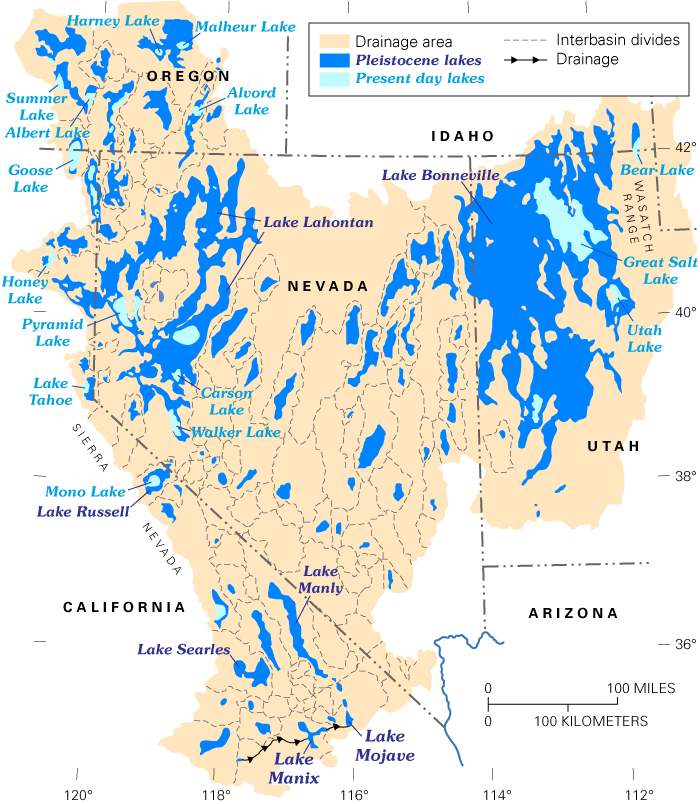
The Paiutes spoke of the red-haired giants arriving and riding around the giant pluvial lake, Lake Lahontan, in reed boats. This is an obvious culture of people who were adapted to lakes. They were reportedly arriving from the south, which would put them likely at the lake cultures of Lake Panamint and Lake Manly in Death Valley as their origins in the Americas, perhaps even the channel islands off the California coast where giants were uncovered in the earth and obvious a culture of seafaring folks.


The Paiutes ancestors referred to these giants as the Si Te Cah (tule eaters) and said that these people lived on reed boats with great houses upon them. The local natives referred to themselves as the Koop Ticutta or "ground squirrel eaters." 


If one were a lake-culture people they would make reed boats and weave baskets that hold water, and create duck callers, duck decoys of great skill, showing they had always lived on water.  

If one were referred to as ground squirrel eaters, they may have technology based upon that focus of their diet and survival. 

Certainly no duck culture remained after the water receded to distant ponds and small scattered lakes. So this had to be in the heyday of water levels at the cave where reed boat riding Red-Haired Giants were trapped by the Paiute ancestors.

Many reports by archaeological sources have placed the items found in Lovelock cave such as the duck decoys and baskets at 2000 years ago, but -

LINK: "Lake Lahontan largely disappeared at 9000 years ago"


The Paiutes repeat that their ancestors reported the red-haired giants having come from the south.

To the south of Lake Lahontan were Lake Panamint and Lake Manly that cradled both sides of what today is Death Valley.

The red-haired giants were reported to build reed boats and navigate on them. We can all concede that had to be a technology they didn't learn overnight. They were obviously a water culture. So, the likely southern location to have learned such technology was in what is today Death Valley.


Interestingly, the southern Paiutes reported the Hav-Musuvs, a people who seafaring and arrived there before they did in the Death Valley area when there was water there. They said they came on rowing boats and used them to go back and forth trading with far-off lands. 

When the water "dried up" (more on that later), the people went underground with their vast technologies and learned to build silver flying disks to sail in the sky instead of water.

It is interesting to note that repeated stories of a Hollow Earth location report flying disk vehicles and winged vehicles in cultures across the globe. Should a culture decide to go underground, they may adapt the technology of those people. 

Although that is a big stretch of the imagination, it is a good practice to take legends and look at them as a necessary knowledge passed down to generations, sometimes through extravagant stories to ensure their retelling, but the events are the focus of the stories, as it was important to always remember.

Both Paiute tribes, north and south, encountered exceptional technology from a strange people. This might further verify the concept of a "giant" prior culture.


Lake Manly dried up 10,000 years ago and Lake Panamint (also in Death Valley) dried up around the same time, although some water remained until 6000 years ago.

Whatever brought these red-haired giants to Lake Lahontan, their legend continues on and evidence of their existence. As well, findings of giant red-haired skeletons and mummies have been reported around the ancient pluvial lake's shores as well as Pyramid Lake, one of the last remnants of the ancient lake. 

Water and flora, fowl, animals, as well as humans abounded along the ancient lake as the last remnants of the ice age melted off. What culture came to the location to live on boats and possibly focus their talents from their homeland on duck calls and decoys? 

We may never truly know as much was lost to the haste of early explorers and also other entities with a focus on a certain story line for humankind that needs to be maintained for cryptic reasons. 

But, if one were to ask us, looking at the quality of the duck caller and the bracelet - it might just be the last of the Denisovans people - seafaring perhaps 10,000-50,000 years ago to the Americas. 

It would have been a 6300-mile journey across a mountainous region (very much what Denisovans were adapted for) and to the sea where their DNA remains today in the people of Oceania, Peru, and the Inuits

Tuesday, February 11, 2020

Forgotten Accounts of Ancient Giant Skeletons Found in Nevada: The Origin of Red-Haired Giants


A special thanks to Dennis Guern and James Carroll for the joint research and giving their feedback on this interesting and detailed article about giant finds in the ancient Lake Lahontan/Nevada region. 

My readers know that I love to give links and show sources of info so that they can go to these places and read more, come to conclusions, form hypotheses....

We will be gathering this information and more into a report so that it can all be together in one place and will let you know how to get that when it's up. 

I have bolded key words to take note of.

Today's post comes from this source - 

Thursday, February 6, 2020

The Odd Light on South Mountain Continues...


Well, managed to pinpoint the spot the light comes from - always the same place. No paths, no hiking areas up the rocky area. If someone keeps going there at night and shining the light, they are not only not leaving a path, but they are doing it in complete darkness as the light does not climb the mountain. It simply turns on there in this desert preserve/largest municipal park in America.

Saturday, September 7, 2019

Don Monroe Case Files: Rope-Knotting Bandit Strikes Again and Again!


In a prior post in the Don Monroe Case files I shared what he was going through with someone randomly tying his ropes around his remote cabin. LINK TO POST

Recently, this has escalated and I'm hoping to find people who might know more about knots than I do. 

Wednesday, July 17, 2019

Lovelock Cave Secrets Exposed! Academics' Misguiding Information


I would like to thank MK Davis, Dennis Guern, James Carroll and Don Monroe for their input on this information and findings. Without researchers with their feet on the ground and their head in their books, we wouldn't make these kinds of gains in understanding. I have long noted strange discrepancies, but with their field work and book work, I'm able to express this in this important posting.

Lovelock Cave in Nevada has long been a location of great debate because of Paiute legends of red-haired giants long ago and their ancestors trapping and burning them within the cave.

In the early 1900s, guano farmers dug through the cave for bat guano and found tons of artifacts and skeletons. The skeletons were said to be giant-sized and having red hair.

Since much of this was disregarded, pilfered, and reburied, a lot of history was lost, but some remains in the form of artifacts that scientists tout as one thing while practical people must shake their heads and scoff. Here's why -