A special thanks to Dennis Guern and James Carroll for the joint research and giving their feedback on this interesting and detailed article about giant finds in the ancient Lake Lahontan/Nevada region.
Showing posts with label red-haired giants. Show all posts
Friday, July 1, 2022
Ancient Giants of Nevada: Lesser Known But Documented Cases
A special thanks to Dennis Guern and James Carroll for the joint research and giving their feedback on this interesting and detailed article about giant finds in the ancient Lake Lahontan/Nevada region.
Wednesday, February 19, 2020
Lovelock Cave and Death Valley
Infamously known as the cave where the Paiutes' ancestors fought off the red-haired giants or "Si Te Cah," there is a lot of mystery in Lovelock Cave's history.
Dennis Guern and I, with the help of researcher James Carroll, have been uncovering more and more interesting correlations between Lovelock Cave and the Death Valley region.
Don Monroe shares a jade duck caller from Lovelock Cave at the local museum. So, who was making this smoothly carved technology?
LINK: Non-patent duck calls may have been made as early as 1850, but the first patent was awarded to Elam Fisher in 1870. In 1863, Fred Allen had created external duck calls, but did not have a patent. Allen's calls were barrel calls with straight tone boards and curved reeds. His most unusual call was the “Allen Nickel-Plated Duck Caller” which was made of metal but froze to the hunters' lips and had to be re-made using wood.
This bracelet (above) oldest ever found was 40,000 years ago and created by the Denisovans people of the Altai Mountains in Siberia. This was a technology way ahead of Homo sapiens in technology at that time.
Here's a comparison with modern humans. We supposedly made this flute around that same time period in Germany - made of a bone.
If there was a duck culture at Lovelock Cave that made amazing duck decoys and callers like this one - the target zone is 13,000 years ago when the land bridge was most ideal for travel from say - Denisova Cave area to North America. At that time period, we were just into making cutting tools.
During this period, what were Denisovans doing also? At 50,000 years ago, they made this needle below -
Technology would travel with the people, as well. And, at 13,000 years ago, Lovelock Cave was ideally above the water line, before the lake mysteriously dried up after 12,500 years ago, nearly completely gone by 10,500 years.
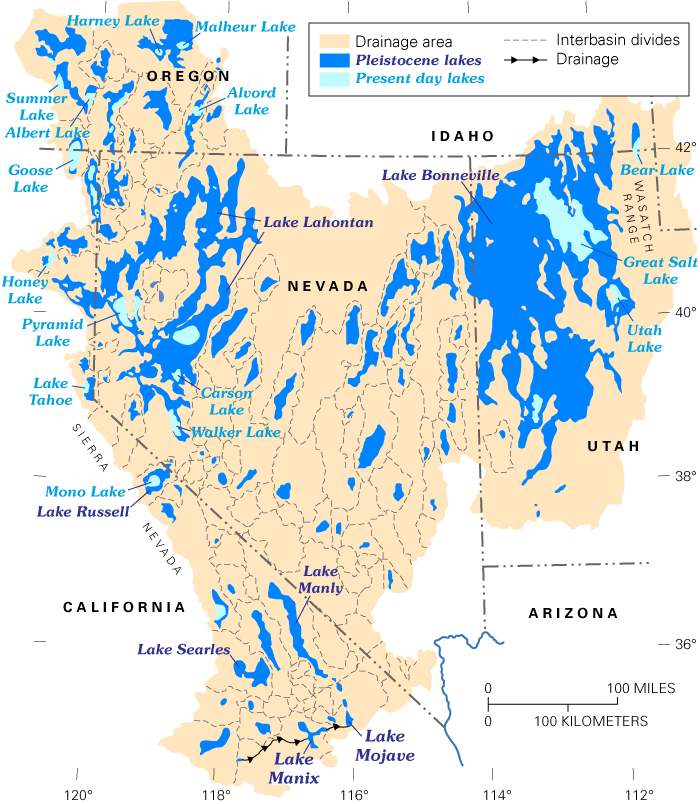
The Paiutes spoke of the red-haired giants arriving and riding around the giant pluvial lake, Lake Lahontan, in reed boats. This is an obvious culture of people who were adapted to lakes. They were reportedly arriving from the south, which would put them likely at the lake cultures of Lake Panamint and Lake Manly in Death Valley as their origins in the Americas, perhaps even the channel islands off the California coast where giants were uncovered in the earth and obvious a culture of seafaring folks.

The Paiutes ancestors referred to these giants as the Si Te Cah (tule eaters) and said that these people lived on reed boats with great houses upon them. The local natives referred to themselves as the Koop Ticutta or "ground squirrel eaters."
If one were a lake-culture people they would make reed boats and weave baskets that hold water, and create duck callers, duck decoys of great skill, showing they had always lived on water.
If one were referred to as ground squirrel eaters, they may have technology based upon that focus of their diet and survival.
Certainly no duck culture remained after the water receded to distant ponds and small scattered lakes. So this had to be in the heyday of water levels at the cave where reed boat riding Red-Haired Giants were trapped by the Paiute ancestors.
Many reports by archaeological sources have placed the items found in Lovelock cave such as the duck decoys and baskets at 2000 years ago, but -
LINK: "Lake Lahontan largely disappeared at 9000 years ago"
The Paiutes spoke of the red-haired giants arriving and riding around the giant pluvial lake, Lake Lahontan, in reed boats. This is an obvious culture of people who were adapted to lakes. They were reportedly arriving from the south, which would put them likely at the lake cultures of Lake Panamint and Lake Manly in Death Valley as their origins in the Americas, perhaps even the channel islands off the California coast where giants were uncovered in the earth and obvious a culture of seafaring folks.

The Paiutes ancestors referred to these giants as the Si Te Cah (tule eaters) and said that these people lived on reed boats with great houses upon them. The local natives referred to themselves as the Koop Ticutta or "ground squirrel eaters."
If one were a lake-culture people they would make reed boats and weave baskets that hold water, and create duck callers, duck decoys of great skill, showing they had always lived on water.
If one were referred to as ground squirrel eaters, they may have technology based upon that focus of their diet and survival.
Certainly no duck culture remained after the water receded to distant ponds and small scattered lakes. So this had to be in the heyday of water levels at the cave where reed boat riding Red-Haired Giants were trapped by the Paiute ancestors.
Many reports by archaeological sources have placed the items found in Lovelock cave such as the duck decoys and baskets at 2000 years ago, but -
LINK: "Lake Lahontan largely disappeared at 9000 years ago"
The Paiutes repeat that their ancestors reported the red-haired giants having come from the south.
To the south of Lake Lahontan were Lake Panamint and Lake Manly that cradled both sides of what today is Death Valley.
The red-haired giants were reported to build reed boats and navigate on them. We can all concede that had to be a technology they didn't learn overnight. They were obviously a water culture. So, the likely southern location to have learned such technology was in what is today Death Valley.

Interestingly, the southern Paiutes reported the Hav-Musuvs, a people who seafaring and arrived there before they did in the Death Valley area when there was water there. They said they came on rowing boats and used them to go back and forth trading with far-off lands.
When the water "dried up" (more on that later), the people went underground with their vast technologies and learned to build silver flying disks to sail in the sky instead of water.
It is interesting to note that repeated stories of a Hollow Earth location report flying disk vehicles and winged vehicles in cultures across the globe. Should a culture decide to go underground, they may adapt the technology of those people.
Although that is a big stretch of the imagination, it is a good practice to take legends and look at them as a necessary knowledge passed down to generations, sometimes through extravagant stories to ensure their retelling, but the events are the focus of the stories, as it was important to always remember.
Both Paiute tribes, north and south, encountered exceptional technology from a strange people. This might further verify the concept of a "giant" prior culture.
Lake Manly dried up 10,000 years ago and Lake Panamint (also in Death Valley) dried up around the same time, although some water remained until 6000 years ago.
Whatever brought these red-haired giants to Lake Lahontan, their legend continues on and evidence of their existence. As well, findings of giant red-haired skeletons and mummies have been reported around the ancient pluvial lake's shores as well as Pyramid Lake, one of the last remnants of the ancient lake.
Water and flora, fowl, animals, as well as humans abounded along the ancient lake as the last remnants of the ice age melted off. What culture came to the location to live on boats and possibly focus their talents from their homeland on duck calls and decoys?
We may never truly know as much was lost to the haste of early explorers and also other entities with a focus on a certain story line for humankind that needs to be maintained for cryptic reasons.
But, if one were to ask us, looking at the quality of the duck caller and the bracelet - it might just be the last of the Denisovans people - seafaring perhaps 10,000-50,000 years ago to the Americas.
It would have been a 6300-mile journey across a mountainous region (very much what Denisovans were adapted for) and to the sea where their DNA remains today in the people of Oceania, Peru, and the Inuits.
Tuesday, February 11, 2020
Forgotten Accounts of Ancient Giant Skeletons Found in Nevada: The Origin of Red-Haired Giants
A special thanks to Dennis Guern and James Carroll for the joint research and giving their feedback on this interesting and detailed article about giant finds in the ancient Lake Lahontan/Nevada region.
My readers know that I love to give links and show sources of info so that they can go to these places and read more, come to conclusions, form hypotheses....
We will be gathering this information and more into a report so that it can all be together in one place and will let you know how to get that when it's up.
I have bolded key words to take note of.
Today's post comes from this source -
Thursday, July 25, 2019
Lovelock Cave Series: The Case For the Red-Haired Giants
For Dennis Guern, MK Davis, Don Monroe and I the case for the red-haired giants is an important study.
Dennis Guern and I proceed to break this down to show the supporting evidence for red-haired giants of Lovelock Cave -
Wednesday, August 29, 2018
Giant of the Day
I have thousands of bits of evidence about giants and it's an overwhelming task, but I want them documented, so I will be doing a giant a day hopefully and it may take me years to show them all at that rate. If you want more giant info, hit he "giants" tab at the top of the blog.
This one from Lovelock Cave in Nevada was 31" tall. To put that in perspective, I am 5'8" tall and my skull is 10" tall.
Friday, February 26, 2016
University Study of Ancient Giants: Proof of Red-Haired Giants!
A few years ago, I posted a very popular article about the slope-headed people/ancient giants. Since then, I've come to more personal conclusions about their origins along the lines of hybrid offspring of Neanderthal/Denisovans. But, it came to my attention after publishing the post that the university paper was removed from the online archive site. I do have a copy of it and I would encourage people to read it and come to their own conclusions. If you want to know the things I pointed out about the contents, please read THIS ARTICLE first.
I am sharing this paper because many have asked to see it and rather than send it privately to people, I thought sharing it openly as I do all other information on the blog, would be the best way to get other minds on the task, other researchers to explore, and curious intelligent folks to determine what they think of these "otamid" skull shapes that showed up around the world and in the Americas in the mound building regions and coastlines.
**I would like to thank MK Davis, one of my most trusted researching colleagues, for bringing this report to my attention.**
(**I am adding this pic below to point out the interpariental bone**)
(Note the triangle piece of bone above - interparietal bone - here is a typical Homo sapiens skull for comparison below)
(** I have put this photo above of a Homo sapiens skull for comparison on rear view**)
I encourage you to read my original article (LINK HERE) where I take this report and point out details. I want my intelligent readers to go on with their own search for answers and to ask some of the bigger questions, like why this paper went underground. It was archived from the university and put onto a university paper site, but then yanked off again, as if someone realized it wasn't supposed to be seen by the public.
In the event, I am forced to remove this from online, I suggest that you glean the info from it that you can, while you can....
Subscribe to:
Posts (Atom)