Showing posts with label cryptids. Show all posts

Sunday, August 23, 2026

Altie the Sea Monster


Loch Ness has "Nessie," the Chesapeake has "Chessie," and the Altamaha River has "Altamaha-ha" or "Altie" (for short).

Wednesday, August 12, 2026

Georgia Bigfoot: Why Bigfoot Settled Where They Did


Now that I am relocated in Georgia from Phoenix, one of the many exciting things about being here is having better access to interactions and studies of the what-seems-magical forest friends. 

Friday, July 24, 2026

The Van Meter Monster


It was in September 1903 in Van Meter, Iowa when over a few days, people began reporting seeing something terrifying. 

Sunday, January 11, 2026

Creepy Mysteries in the Desert Southwest

Red Ghost

The American Southwest is romantic to some and brutal to others. This fantastic beautiful and yet deadly combination has brought rise to an array of cryptids and creepy legends. Here's just some - 

Sunday, January 4, 2026

American Cryptids

Admittedly, when it comes to cryptid creatures, America packs a list too long for just one post. I'm going to share some of my favorites -

Monday, April 14, 2025

Rock Apes Encountered in Vietnam War


As if war itself isn't monstrous enough, during the engagement in Vietnam for 19 years in the 50s, 60s, and into the 70s, there were encounters between American forces and, well, a cryptid even the Vietnamese had reported for a long time.

Thursday, September 23, 2021

Scary Finds by Forest Rangers


Park rangers cover a lot of ground and responsibilities. They can be in very remote areas and camping out. What they run into out in the wilds isn't always your usual bears and raccoons. Oh no, they run into the unexplained or dangerous....

Sunday, March 1, 2020

Reptoids Under LA?


From 1934, G. Warren Shufelt reported to the Los Angeles Times that he had discovered a series of caverns under LA that houses Reptoid people in ancient times.  Reportedly, 5000 years ago a huge "tongue of fire" obliterated the Southwest and these people were forced to go underground. Reportedly, they had made tunnels in an upper and lower grid. The lower grid allowed sea water to rush through and force clean air into the upper level. There were rooms that were like "high rises" underground where they stored herbage for food.

Supposedly, according to Shufelt, some tunnels ran 20 miles under Santa Monica Bay and were used for ventilation.


For a comprehensive writing about this intriguing story, go here.  Here's a short clip from the info there;

"The "Lizard People" of Los Angeles survived the meteor shower, but were killed by natural gas leaking into their bunkers. Shufelt believed that they had built 13 such underground facilities in different areas for such a purpose. One was located in the eastern section of Arizona in a small town called Springerville and was only discovered recently. 

Another was located under a hill which was surrounded by a curving ridge of mountains like the middle of a horse's hoof. This is exactly the type of terrain seen in downtown L.A. in the area that is now the Board of Education, which is built over the ruins of the old Willis Estate on top of Fort Moore hill. Shufelt and his partner Chief Little Green Leaf were both convinced that the ancient legends and the readings from Shufelt's mystery machine were true.

They decided to obtain a permit to sink a shaft down into the ruins of the subterranean city. They located a vacant lot at 518 North Hill Street, directly above one of the largest rooms. On 21st February 1933, the County Board of Supervisors approved a contract with Rex McCreary, Warren Shufelt and Ray Martin to search for buried treasure there.

The permittees were to bear all expenses, to leave the property in its original condition, and to share 50% of all discoveries and treasure with the city of L.A.

The county originally only allowed them to dig up to depths of 50 feet for fear of cave-ins. On 27th March 1933 they requested additional time and depths on their permit, believing that the labyrinth of tunnels was at least 1,900 feet in length, with rooms containing 9,000 square feet which contained valuable gold treasure in at least 16 places.

On 10th April 1933 the contract was renewed. By the end of November in 1933, the main shaft was at a depth of 200 feet. Shufelt was determined to drill to a depth of 1,000 feet if necessary. On 29th January 1934, the first stories regarding the legend of the "Lost Land of the Lizard People" made the L.A. newspapers. By this time, one of the five shafts was already 250 feet deep
.

According to the legend and the radio surveys, the underground city was laid out in the shape of a lizard, with its tail under the Main Library at Fifth and Hope, and the body extending Northeast, with the head being at Lookout and Marda near North Broadway. The key room to the city was located under Second and South Broadway.


The legends state that the key room is the directory to the rest of the city, and to the historical gold record tablets. These gold tablets were slabs of gold, 4 feet long and 14 inches wide.

The tablets were believed to contain the records of the origins of the human race, and the history of modern man in the Americas, including details regarding the history of the mysterious Mayan people. Shufelt's radio-wave machine mapped the rooms and tunnels as subsurface voids, with the gold slabs as dark areas, showing perfect geometric angles.

The rooms, seven of which occurred within an area of six square city blocks, varied in size from 23' x 23' to 34' x 42'. The room below the first shaft was 31' x 42', and the key room was the smallest. Water had seeped into some of the tunnels, and several of the rooms including the largest were flooded. Shufelt was prepared to use divers to explore the submerged areas when they finally broke into the subterranean city."

Interestingly, in his account, Shufelt reported the tunnels appeared to be burned out by some kind of chemical process or such. But, caves reported in California associated with "reptoid" beings are often reported as glazed on the walls.

Mt. Lassen in California is said to be one such location with the "glazed" tunnels. In fact, some men in the 1940s said they explored the tunnels way up high on the sides of the mountain and were dispatched by some officials they said were under the mind control of beings inside.

Many locations in California have legends of tunnels with strange beings, government and alien experiments, and caches of gold. How many such tunnels could still exist, given the tectonic activity in the state? 

Would a strange race of lizard-looking people build a civilization underground? 

Well, the theme is repeated. The Grand Canyon (newspaper - 1909 Phoenix Gazette) had been the site of a reported race of giants who moved into a cavern to weather out a cataclysmic event, taking with them seeds and animals of their culture. The Hopi people in the area had legends of ant people under ground who helped their people survive. 

Then, in Death Valley, there were reports of caverns inside the Panamint Range that housed relics and gold, and giant mummies of a culture that was hiding out in there (book - Death Valley Men). 

Was there a horrendous event long ago that drove cultures underground? And what might those culture have been like if they were original cultures of the Americas? Perhaps having evolved far away from the rest of us "modern" people? 


More info:


Friday, September 6, 2019

Melissa George: Cryptid Author Worth Reading!


Upon occasion I am privileged to get to know and really respect other researchers in the field and other authors doing incredible things. 

In this case, Melissa George got on my radar and stayed!

Monday, November 5, 2018

Thylacine Sightings: Tasmanian Tiger


This "Ozenkadnook Tiger" photo was taken in 1964 by Rilla Martin in Southern Australia. She reported the snout to be pig-like and it was about the size of a labrador. Although it has the stripes of the extinct thylacine "Tasmanian Tiger," the features and proportions seem different. In fact, it is compared to the very-long extinct Marsupial lion.

Tuesday, August 29, 2017

Pterodactyls: Are There Still Dinosaurs in the Sky?


People today report seeing pterodactyls. Is it a trick of the eye as we are viewing flying creatures from a distance or is there something highly unexpected still flying in our skies?

Monday, August 31, 2015

Unexplained Creatures Found!


Looks creepy, eh? This one was explained. It was found to be a newborn baboon, killed by a bite through the skull which is not unusual in that group of animals to have infanticide.


The African troll (above) video made its way around the internet. According to the hunters' story, they shot one and chased it into a lair where there were more they had to do battle with. 


This creature (above) was found in Russia on the beach. It has skin with hair or fur. It was not an alligator, fish or crocodile. It was taken away by Russian special services. What it was? Still not reported.


This critter (above) was found in San Antonio, called a chupacabra, one of the odd hairless, hopping, bizarre looking dog-like creatures being discovered fairly often in the south.

In 1954 in England a "monster" was found that came to be called the Canvey Island Monster. "The 1953 specimen was described as being 76cm (2.4ft) long with thick reddish brown skin, bulging eyes and gills. It was also described as having hind legs with five-toed horseshoe-shaped feet with concave arches – which appeared to be suited for bipedal locomotion – but no forelimbs. Its remains were cremated after a cursory inspection by zoologists who said that it posed no danger to the public. The 1954 specimen was described as being similar to the first but much larger, being 120cm (3.9 ft) long and weighing approximately 11.3kg (25lb). It was sufficiently fresh for its eyes, nostrils and teeth to be studied though no official explanation was given at the time as to what it was or what happened to the carcass."


In 2008, something washed ashore in near Montauk, NY that came to be known as the "Montauk Monster."  Many believed it was the result of animal experiments on Plum Island nearby where the government did animal testing. Ultimately, a naturalist pointed out that it very much did appear to be a raccoon without  its fur and decomposing.


The Brooklyn Bridge Monster of 2012 (above) was thought to be related to the Montauk Monster.  It washed up under the Brooklyn Bridge. This one was explained by one "expert" as a dog that washed ashore, its hair having slipped of its body and being bloated. Doesn't explain the claw or beak.

What I don't understand is why no one ever picks up these things and take them to a vet or someone?


This 30-foot creature washed up on the shores in New Zealand (above). This was thought to probably be an Orca whale.


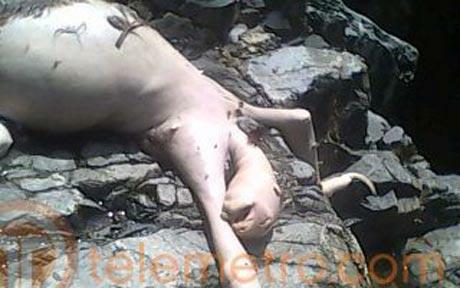
The Panama Monster is an interesting story. In 2009, the creature was found by some teenage boys near a cave where they felt threatened and hit it with sticks and stones and killed it. Some saw the photo and called it a hairless sloth. Supposedly, a sample from it showed that it was a brown-haired sloth.

Interestingly, most all these "monsters" washed ashore. What the water does to fur and skin, bloating the body, decaying away jaws and such, leaves something that barely resembles the original form. Still, within all these pictures above; I have to wonder which one might truly be unexplainable?


Tuesday, December 9, 2014

America's Crazy Cryptids


I'm sharing just some of the amazing array of cryptids reported in the United States. Local areas have many of their own that have grown over time, such as my hometown's Bunnyman that was at one time a man who ate bunnies, then a man in a bunny suit, and over time has been thrown into the cryptid pile. 

Lizardman:  In Tucson, Arizona during a bike race, a rider saw a Lizardman standing in the desert. “We had been riding for about… I don’t know maybe nine hours, taking breaks every now and then. Then Michael says he needs to stop for a minute. We are waiting for him to finish when all of a sudden we see this long figure walking across the trail. He is maybe about 6-foot tall, very very skinny, and it had an awkward gait, like a monkey…or a man with a disease, almost robotic, kind of,” he told Cryptozoology News.


Horned demon creature of Felton?


Goatman


Jersey Devil


Sheepsquatch


Thunderbirds


Altamaha ha


Dogman


Ozark Howler


Alaska Lake Monster


Pope Lick Monster


Skunk Ape


Sasquatch


Lizard man of Scape Ore Swamp


Was it really any wonder that the Native People have repeated legends of man/animal forms, dance in costumes that portray them? 


Then, there are also the campy cryptids - 

Batboy


Jackalope

Man has been pretty arrogant about ruling the earth and knowing all of its inhabitants and yet every year, even large creatures are discovered "officially" for the first time (thought Native people knew of these creatures). It's a fascinating land, America. We are not such a new continent. Technically, all continents were from a master continent and broke apart. We are as old as any other continent and what happened her had isolation for millions of years before humans arrived in a place that might have already harbored humanoids. 


Friday, August 1, 2014

Who Is Dogman's Daddy?


Ever since Dogman was first reported, lots of variations have been described. The problem becomes one of chicken or the egg dilemma. Because people reported seeing a bipedal creature with what appeared to be a snout and a hair-covered body, werewolf/dog became the comparison. We did much the same when Sasquatch showed up in popular talk in the 1950s and because he was upright and hair covered, he was compared to a gorilla. Soon, people commonly accepted Sasquatch as a gorilla and Dogman as a dog variation. Therefore, much research has been on the assumption of a canine and its habits and tendencies, much like people thinking Sasquatch would think and act as an ape. 

There are often witness embellishments including more dog-like features, like pointed ears and a tail and it's difficult to determine if this is people equating what they were seeing with a dog-man and assuming features other than the obvious snout and hair. 

We don't get far in cryptid research when we classify something and then make assumptions. There can be no assumptions about Dogman's origins. We must treat it as a set of circumstances, locations, encounters, and physical features that give rise to a possible explanation. 

I think we can all agree that the notion of a dog-human mating is an enormous jump from what we could consider "Occam's Razor" or the concept that the most simple explanation is probably the accurate one. 

So, before we jump to alien hybridization and otherworldly beings, I'd like to try some real-world explanations for these "features."

Let's begin with a potential lineage for Dogman - what are his origins? What creatures have been in America for millions of years and which ones might have survived long enough to evolve in seclusion? What kind of creatures have a tendency to be shy and forest or arboreal-focused. 


Above: This chart demonstrates the two branches of primates that split off, one below giving way to tarsiers, new world and old world monkeys, apes and humans, and the one above giving way to lemurs and lorises. Notice the one fellow who is on the upper branch that leads to lemurs and lorises? They recently found him and they are continuing to find others who fit into the limbs closer to the millions of years ago mark. All of these primates emerged from that one common ancestor on the left, but supposedly only the ape line managed to create upright intelligent beings. The lorises and lemurs, though originating from the same progenitor, did not manage to create an upright or intelligent being, hmm? 


Evolution  

We know what happened on the ape branch - humans, but what happened on the other main branch, was their outcome the simple lemur for the same millions of years? 


 Streptsirhines Branch 
(referred to as "wet nose" of evolutionary primates)

Some of these qualities are quite interesting like the tapetum lucidum - the membrane over the eye that could cause eye shine and a nictating membrane, as well that would protect the eyes from branches and such (something you might have read about in the recent post on here by Karl Sup about his eye hypothesis for Bigfoot).  They were also described as nocturnal, solitary, terrestrial and arboreal, having a tooth comb, grooming claws, occupy niches of higher primates, very large eyes.

What if these "wet nosed" creatures did, in fact, have the same occurrence on their end of the primate tree? What features might that upright being have? Timidity? Shy tree-loving? A snout? Nightvision? 


The Americas had lemurs and sloths, even giant sloths, up until 30,000 years ago, and the lemurs were believed to have died out. What if they had a branch on their section of the tree that produced an upright being? This would need a fair amount of intelligence to survive up against large creatures. They would have to work on skills of arboreal (tree) living as well as out thinking the predators to become exceedingly reclusive. 

There are carnivorous lemurs. There is no reason to think they might be as close as a chimp and a human, with the human growing smarter, upright, and taller. The lemur could very well have had a cousin that grew taller, upright, and smarter.


Source:  Most eosimiidae species are documented by unique or fragmentary specimens. This, as well as the strong belief that simians originated in Africa has made it difficult for many to accept the idea that Asia played a role in early primate evolution. Although some continue to challenge the anthropoid resemblances found in Eosiimidae, extensive anatomical evidence collected over the past decade substantiates its anthropoid status.

Wikipedia: Dating has proven this genus lived from 40 to 45 million years ago in the middle Eocene. The genus Eosimiasis unique because of the presence of primitive and derived traits. It provides new insight into the phylogenetic relationships. 

Truth: Our knowledge has holes in it - 

The original continent that made up the land mass of the world, referred to as Pangaea, broke up apparently 100,000,000 years ago. What early common ancestors did it contain? Well, before it broke off, it must have carried lemurs and New World monkeys to the American continents. I'm a little confused here, how did lemurs and New World monkeys make it to America if the continents broke off 100 million years ago and yet "Archiecebus achilles" (below) is the oldest primate found, meaning it was older than lemurs and this was 55,000 years ago and "Ida" (below) was the oldest common ancestor between lemur and human 45,000,000 years ago. Sometimes, explanations get a bit wishy washy in the world of archaeology about whether primates evolved in Asia while evolving in Africa, and yet we know of Peking Man and Java Man. 


(Above: Oldest primate found in China - Archicebus achilles that lived in what is now central China during Eocene about 55 million years ago.)

SOURCE:  The find, described in the journal Nature, is the oldest known fossil primate skeleton. “This is the oldest primate skeleton of this quality and completeness ever discovered and one of the most primitive primate fossils ever documented. The origin of primates sets the first milestone for all primate lineages, including that of humanity,” explained co-author Dr Dan Gebo, an anthropologist with the Northern Illinois University.


"IDA" - Germany 45,000,000 oldest branch between lemur and human discovered and called Darwinius masillae. She is 45 million years old and considered one of the most extraordinary finds in the early primate family.  

If lemurs branch is a possibility let's have a look at how a lemur (non-evolved into upright) stands - 


Do we now have that sort of digitigrade stance of a dog if you stand him up on his haunches. Their feet were not designed for walking on upright like our plantigrade ones. Many report this haunched-look to the legs of dogman.

Evolution is, of course, applied to all life forms, so it is relevant to the Dogman. No matter how romantic it is, he did not just drop from the sky. But, there is more to the possible origins of his "evolutionary" process.  

Let's look at another real possibility:


Hybrids  

There are humans and then there are apes side by side and what if the streptsirrhines produced both a large more feral descendent (ape like) and an intelligent civilized being? Here might be case for that intelligent offshoot - 

From the book The Natural and Aboriginal History of Tennessee by John Haywood (starting page 200 on reprint edition from Amazon): Referred to as "pygmies," these skeletons were found buried in crypts just outside of Sparta, Tennessee in the County of White and reported in the Nashville Whig in June 1820.These graves had many bodies, all of them quite small. Some of the crypts were as small as 18 inches by 12 inches. The first grave was 2 feet long and inside the small skeleton and its teeth had the researcher wondering if it was canine or monkey. He had them sent off to be examined.  They were buried with care in a stone crypt and had shells and urns with them. The bones were so old they crumbled quite easily. One skull the examiner held up was 5" across from side to side.  Most individuals were from 18 inches to 2 feet 10 inches long. One find was a 5 foot 5 inch individual found with the smaller ones. The taller skeleton had a head that was longer, eyes much wider asunder, the forehead much higher above the eyebrows, and the under jaw measured one inch longer on each side than the smaller fellows.Atop the head of one skull had bright silver grey fine hairs.There was great dissimilarity in skull shapes, the size and shape of the bones, and looked to belong to different tribes of people. Just 8 miles away, a 7-foot giant was found.


Let's look at another very real world possibility -


Did you know that in the primate world, if you hybridize two baboons that are in different "types," you can get some interesting features? Their snouts get boxier, they get extra teeth, and bigger faces. It wouldn't take much to imagine a Sasquatch and another Sasquatch of separate "types." Reportedly within the Sasquatch family, there are ones with bigger foreface, some that look quite human, some that look like apes, and many variations. These could all be different "breeds" of their kind or "races" as we would put it. When you hybridize, some features are more pronounced.


(above - Baboon types hybridizing)

In the case of lemurs, they are only found on Madagascar, but they were all over the globe at one time, believing to have died off eventually and thriving on the island because of isolation. What if their common ancestor was on the Americas when they broke off into their own continent? What would the variety have been here?  And if they mated between two distinct breeds, what sort of "robust" characteristics might they have created?


Best candidates in America for dogman evolution


We would need to open our minds up about the origins of Dogman in America. We have two avenues to explore - either an evolutionary descent of New World monkey family or another intriguing possibility I will discuss in a while.

First potential candidate - 


Megatherium Americanum (giant sloth of Americas)

Source:  Paleontologists in Uruguay published findings in November suggesting that humans hunted giant sloths there about 30,000 years ago. This is an interesting concept because it supposes that humans were in the Americas 30,000 years ago. Oh, I think it was longer than that. Man aside, let's look at the giant sloth. We know they have some characteristics described in dogman and were here up until 30,000 years ago, but unless their fossils are vastly different than earlier giant sloths, that is not enough time for an evolutionary change to what people describe as Dogman. Let's look for a critter who might have become upright who was here much longer ago - 


In the drawing above is tarsius eocaenus (dog in that name). 

Tarsiiformes - tarsiers are a group of primates that once ranged from Europe to Asia, Africa to America, but today are only found on the islands of Southeast Asia. This is intriguing when you consider forms of them that might have evolved over time on those isolated islands where eventually many thousands of years ago, ancient giants (or as I call them Originators) came to spread out over those islands as they conquered the earth long before homo sapiens. It is a possibility that these evolved upright beings were taken upon their ships and brought with them to the new world as a novelty or even as a slave labor for their lesser intelligence. 


New World Monkeys - 


Homunculus patagonicus

This New World Monkey was found in Argentina estimated to be from about 23 million years ago.  More than enough time to evolve into another form of man. We know that in China, other forms of man were developing, like Java Man and Peking Man and that was outside of Africa. These new world monkeys many millions of years ago could have shared a common ancestor when they developed in the Americas, one that lead the path to an upright intelligent being, perhaps even a form of man we eventually called the elongated skull people of Paracas and also perhaps having taken a whole different variation. The skull shows the potential for an eventual long-faced upright being.

This fellow might be the BINGO in the group - 

Bear-Dog


Now, here's a real candidate - the Bear-Dog. Amphicyonidae were large terrestrial carnivores in North America, Africa, Europe and Asia from 46.2 million years ago to 1.8 million years ago, existing for an amazing 44.4 million years!  It doesn't take much imagination to consider 1.8 million years of evolving into a form we might know and see today as Dogman. In that period of time. Just look at this fellow who was us 1.8 million years ago, referred to as Skull 5. 


The interesting thing about the Bear-Dog is that they had proportions like a dog, but a build like a bear. Many report a bear-like snout on the dogman. They were also thought to be plantigrade instead of digitigrade like dogs are now. This means their feet landed on the ground flatly like a bear (plantigrade) instead of a dog (digitigrade), and we know how bears can stand. Even paleontologists have a hard time classifying these fellows. They were thought to weight less than 100 kg which would be below 220 pounds. However, considering the size of man this many millions of years ago and the ones walking around today, the evolutionary process had us standing erect and growing in height. If such a process occurred to the Bear-Dog, we would have an excellent candidate for Dogman.


Conclusion

I believe any of us who find validity in the existence of a race of intelligent and very robust beings that had advanced technology and are often referred to as ancient giants and those with elongated skulls in Peru, would find this fascinating because it implies that separate lineages of man-like beings were branching off all over the world and some were here much longer and were more advanced than we thought. 

This gives rise to the concept that from man there were Peking Man, Java Man, Aryans, Giants, homo floresiensis (found in 2003!), Homo sapiens and others not yet identified, and from early lineages of other species, there could have been evolutionary offshoots and beings here that we have not accounted for yet. 

How about the oldest primate found in the Americas? The Branisella was found in Bolivia and dates back to about 26 million years.  This is rather interesting, isn't it? If this major continent broke apart 100 million years ago, then these guys arrived 26 million years ago from where? Yes, more of those gaps in knowledge. Interestingly, the Bransiella is hard to relate back to other Old World monkeys, according to experts. Now, you put him on a continent separated and imagine what his evolutionary process might undergo. It would be something quite "other" than what occurred in Africa and other continents with primates. 


An evolutionary offshoot of the "wet nose" primates? Hybridization between Sasquatch? 
Evolved process of the Bear-Dog? 

The possibilities are endless when you consider the process of evolution and the candidates that might be progenitor to such an oddity. The key here is to walk away from the canine classification and open the door for real origins of this elusive being. 


As always, I encourage your own voyage into research. Here are some links to check out: 

Lemurs
Giant Sloths
Dawn of humans in America
Primate brain evolution 
Bear Dogs
Oldest New World Monkey