You have to wonder about witness accounts when there are so many descriptions of how a Bigfoot looks and such a variety of ways to portray it. First, let's look at some of these variations in perception -
We utilize farmer's markets to get freshly grown items to enhance our cooking experience, but many chefs find items grown in the wild to be exotic local tastes to add to their dishes. They consider it a natural enhancement, but the woodlands really were the first growing sources for food.
If you ever worried about Sasquatch's diet, consider this - they live in a wonderland of fab foods! Let's just take some of the things they work with and consider the gourmet properties, medicinal, and nutritional benefits. Wild Boar: (1 pound of raw meat) 544 calories, 262 mg of cholesterol, 96 grams of protein Deer: (1 pound raw): 336 calories, 80 mg of cholesterol, 96 grams of protein Catfish: (1 raw fillet) 215 calories, 75 mg of cholesterol, 25 grams of protein Fresh water mussels: (3 ounces) 70 calories, great source of vitamin B12.
Now, let's wonder into the Sasquatch produce aisle, shall we?
Juniper Berries
Juniper berries grow on juniper shrubs in the wild. Their medicinal properties have been used to alleviate anemia and give stamina, energy, fighting off flus and colds, aches and pains. In general, an anti-inflammatory and energizing effect. They are used to make gin and have that sharp taste, but also can be used to cut through gamey taste in wild meats. Great with game meat, but also in soups, it can be roasted to make a great coffee substitute.
Sasquatch signs: If bushes have been freed of their berries, even up high where deer do not reach, this might be a sign of Sasquatch nibbling.
Recipes
Salmon Rub: Dried juniper berries crushed in a spice grinder with Earl Grey tea. Sounds wild, huh? Well, a very hip Scandinavian chef understands the bergamot and juniper make an amazing taste when curing the salmon and searing it.
Fiddleheads
The unfurled fronds of fern plants, fiddleheads are a gourmet cook's treat. They are harvested very early in the season before the frond unfurls and cut close to the ground. They are served as a cooked vegetable. They are kind of like if asparagus met string beans in taste/texture. They have a short season, so you must harvest in the spring while they are available. They are very high in vitamin A and has about 44% of your vitamin C needs for the day.
Sasquatch signs: If you can't find fiddleheads, there might be a reason. Look around those ferns in the very early spring and see if they've left some prints.
Recipe
Saute the fiddleheads in butter, garlic, red pepper flakes and salt for 10 minutes.
Wild Grapes
Much of today's grapes have been hybridized to be seedless, but sadly the important antioxidants are in those seeds and indigenous people did well eating those for their diet. A diet is the array of foods a being needs to ingest to get proper nutrients for cell turnover, growth, maintenance of weight, and immune system support. Wild grapes are a healthy source, but also need to be carefully looked at. A wild grape has multiple roundish seeds inside, but the poisonous moonseed, has a single crescent-shaped seed. Knowing this you can keep from being sick. Of course, we all know grapes are great for jellies, jams.
Sasquatch signs: These vines/bushes are an easy snag for Sasquatch hair while nibbling on the yummy treats. I'd say, come back when berries and grapes are fermented and see if they might have dropped some inhibitions, left some stumbling marks (see notes at the end of this post)
Recipe
Morels
Morel mushrooms. Lots of folks in woodland areas appreciate foraging for these gems in the woods. It has become a family pass time for many generations. This honeycomb topped fungus is a gourmet delight. They are rich in B-complex, vitamin D and essential amino acids. They also potentially lower the risk of breast and prostate cancer. At a going price of $10 to $20 an ounce, gourmet cooks consider them gold.
Recipe
Slice morels length wise in half. Heat oil over medium heat. Mix 3/4 c milk with 2 eggs. Break up one 4-ounce package of saltines. Drip into milk/egg mix and then saltines and carefully drop into hot oil. Flip when golden brown - they cook fast. Drain on paper towels and then salt and pepper.
Sassafras
Most of us know sassafras for its root beer flavor and the root's tasty tea. The medicinal properties of sassafras are pretty significant. It's effects are far reaching from handling colds and flus, diuretic properties, and topically, it helps poison ivy and eczema. The leaves, roots and shoots are all edible.
Recipe
Wild Leeks
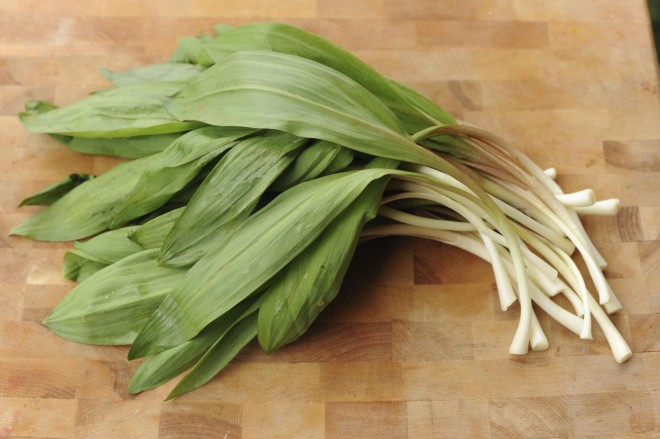
This plant (aka "ramps") has leave and bulb that smell like onion. They surface deep in the forest early in spring before other things pop up. They are high in vitamin A, vitamin C, selenium and chromium.
Recipe
Pizza with fresh leeks and morels is about as good as it gets. Drizzle a trace of truffle oil on top and you have a woodland pizza!
Dandelion
Dandelion might be thought by some as a weed, but all the parts are edible. Some people confuse dandelion with "false dandelion" or "Hawksbeard."
The greens, tops and roots all have medicinal qualities. They have a high amount of vitamin A, tons of vitamin K, and vitamin C. They can be used to make wines, put in soups and salads and more. My mother used to candy them for atop of cakes.
Recipes
1-2 cups of flowers, 1 egg white at room temp, 1 tsp water, 1/2 c. superfine sugar, a drying rack.
Put sugar into blender to grind to a fine texture.
Mix water and egg white and drip flowers in it, let drip and then sprinkle with superfine sugar, set on rack and let dry and harden into shape.
Chickweed
Chickweed is chock full of healthy stuff and tastes sort of like spinach. They can even be grown as a pot herb and used on salads. It can be used to constipation, coughs and colds, a diuretic and expectorant. In fact, when I used to make herbal teas, this was in my head cold mix - with some other goodies that helped alleviate mucus symptoms and boost immunity.
Recipe
Use chickweed for a pesto! 2 cloves garlic, 3 tablespoons of pine nuts (discussing those next), 2 cups chopped fresh chickweed, 1/2 c. olive oil, 1/2 c. parmesan in the blender.
Pine Nuts
These sought after gourmet nuts are harvested from pine cones. They are ready to harvest 10 days before the green cone begins to open. The cones are dried in a burlap bag in the sun for 20 days. Cones are then smashed and seeds are separated by hand from cone fragments. (be sure to check your forest floor for signs of smashing by the Sasquatch - they often do this on tree stumps with a rock). These are calorie packed so great bang for the buck for the Tall Ones. They are also high in vitamin E.
Recipe
How about cooking quinoa with pine nuts, raisins and garlic? Add a little olive oil and some fresh diced parsley.
Fermented berries and grapes
(Is Sasquatch a berry crack whore?)
Raspberries, blackberries, juniper berries and wild grapes all ferment on the vine and then what happens? Well, sometimes it's too good to pass up!
This is only a fraction of what is available in the wild. I didn't even delve into things like various mushrooms, roots, berries, greens, seeds, nuts, and other sources of dense protein.
I believe in backtracking in research. I study who Sasquatch descended from so I can legitimize their very existence. They have to have a lineage, just like we do. Most of us arrived on second or third migration to America (Native American and Europeans). It is my conjecture, they were part of the first migration or what is referred to as the ancient giants. They have the same skull shape and the same size and they are heavily populated not far from ancient giant civilization lands. That is my own take on it thus far, but they had to come from some lineage of man.
In the case of the woods, it's easier to find where they are going by where they have been; which areas they depleted of resources on their circuit. I also believe they show a great amount of restraint in eating things in a grazing manner, leaving adequate resources behind to not draw attention to or lose their food sources in that area, so they mark the spot with perhaps an arch or an X. That lets them know - I've fed here already but some remains. It is kind of like putting out McDonald's signs along their roadway to know where the next rest stop is.
Another thing to consider in their diet is metabolism. The Sherpa people were found to have a gene from Denisovans that allows them to carry more than their body weight on their backs and their metabolism only rises about 50% of what people without that gene would do. If Bigfoot has a common ancestor or adaptation, the may be the same as the Sherpa in that respect. Caloric needs may not the same ratio as ours and their strength to carry a load would be increased. So, a muscular Bigfoot may not be necessarily downing 10,000 calories a day like an athlete whose metabolism needs it for that load.
Don't worry about the Sasquatch, they are well fed. We could learn from their example and do a little foraging as our ancestors had. There are many medicinals and high protein, high nutrient foods in the woods and, as some clever chefs have found, they are gourmet finds!
This is the reporting by a Bigfoot researcher of an ongoing study in the Southern part of the United States in a very large park area near homes and urban setting.
Today, I decided to bring back some food items to the sight. I can't get it out of my mind that raccoons didn't take all the food offered this year at the sites. The food offered this trip included: 2 bags of popcorn, 2 bags of peanuts and 2 large sweet treats.
I arrived at the parking area at 1:58 PM. The temperature and conditions were 50 degrees, cloudy and breezy with a light mist. I continued to do my basic bike riding on this visit. After riding approximately 15 minutes close by at 2:15 PM, I was back at my car and loading up my backpack. I typically go to the far P.R.O.W.site first but decided to go to site 1B instead. At 2:35 PM, I arrived at the 1B entry. I parked my bike just inside the tree line and did a walk on the grassy area along the ditch to the creek. I haven't done this in some time. I didn't see anything unusual as I scanned the area. What really staggered me though was the amount of trash brought down the creek from the recent flooding and rains. Where logs and debris in the creek build up, there was a lot of trash caught at those spots. It's really an eyesore, but nothing can be done about it. All the new trash pockets will come up over the banks from the creek and flow over into Sites 1A and 1B. When I decide to explore back into site 1A, I will find new water meter covers and more balls.
I finished at the creek and went ahead into 1B. After walking the whole site nothing looked out of the ordinary. Nothing was changed or new. I added and changed a few items. The following photos show these items.
#1 thru #5. At 1B, I bring back the large tool bag and hang from a nail on a large tree near one of my boundary markers (a spot painted plastic,garbage can lid, plus hanging, yellow caution tape, and a plastic cover with a 'BF' drawings sheet. All these hang from a low limb.) In the tool bag. I put 1 bag of popcorn, 1 bag of peanuts, 1 sweet treat, the comb, tent pegs: yellow plastic and 1 metal with green plastic parts, and a hand axe. I also added a chain as an obstacle. I wanted to see if the chain would be moved.
#6. The buckets with the found balls from the area. In the dark bucket, I add a old plastic cup upside down. Will it be messed with?
#7. I add my old plastic poncho under 'Wilson'. Please 'FP' take them!!
#8. The bear doll is till sitting on the limb. My stored items in the pipe. Nothing has been taken.
#9. If I didn't mention before, I was grabbing the small ball from the crook of the limb near the pipes. It fell from my hand and rolled into the ground, animal hole opening. When I reached to get it out, I accidentally nudged it. The ball rolled under ground. I was surprised. The hole is deep. The ball could not be retrieved. This photo is of that hole.
#10 thru #13. I removed all items from the pipes and water meter covers. I stacked the red meter covers and put items in in the bag and left as you see. I also laid out another 'BF' drawings sheet.
After completing the above it was time to move on to the P.R.O.W. It was now approximately 3:25 PM. I Rode my bike to the far trail and made it back to the P.R.O.W at 3:55 PM. As I walked the area, again nothing seemed to be changed or out of the ordinary.
#14. and #17. I brought with me the other bag of popcorn, bag of peanuts and sweet treat. I also brought one of my used, small backpacks to hang on a nail from the knife gifting tree. I put the food items in the pack and left it hanging. This is approximately 5'10" off the ground.
#15., #16. and #19. I also hung a length of yellow caution tape from the tree I had taken pink marking tape from recently.
#18. An unusual tree arch. Looks like it grew into this shape. I may use this tree for future setups.
The area here is swampy after rains. It takes quite a while to dry out. There is something to this spot.
It's 4:10 PM and I leave the area. I expect something to have happened by my next visit.
This concludes filed report #37 for Sunday November 29 2015.
Today's concept is probably not a surprise to anyone - the correlations between ancient giants and Sasquatch - and they are many and significant, as I will be laying out for your consideration.
One by one, I plan to take you through features, similarities and possible correlations between the ancient giants and the modern-day Sasquatch. You might be surprised how this all works together like a precision puzzle.
Physical Features
Head:"Sloped forehead, pronounced brow ridge, crowded teeth with protruding looking mouth region, pointed back of the head, powerful mandible (jaw)." These are all reported by witnesses of Sasquatch. Interestingly, these are the same things reported on the skulls of ancient giants. In fact, in my post about the slope-headed ones (perhaps the First People of America), the skull showed a sloped forehead, pronounced brow ridge, crowded teeth and an authentic os inca bone in the back of the head, creating a pointed head shape in the rear. Interestingly in Peru, where elongated skulls were found of ancient origins, there is also a reported tribe of feral giants as reported on Bigfoot Encounters: Lima, Peru May 22, 1976--- A one-eyed Indian tale of battling a band of red-haired hunchback giants has caused speculation that a tribe of stone-age aborigines may inhabit the jungles of northern Peru. The men were described as olive-skinned, barefooted, hunched-back, more than 6 feet 6 inches tall with feet twice the normal size... Carlos Tarrealza, discoverer of the ruins of a lost Indian city in San Martin Province said he had found the giants when he was lost for two weeks in the jungle. He said they were clad only in animal skins with reddish hair and spoke a dialect he had never heard. He said they fled at his approach.
Other countries with reports of ancient giant finds with sloping skulls and present-day Sasquatch-like beings include Siberia, China, Australia, Himalayas and more.
Height: Average height of sighted Sasquatch is at about the 8-foot range. Ancient giant bone finds put the average at about the 8-foot range. Given that there were numerous ancient giant buried remains found in America and there is a reported race of giant people with the same skull shape and height - it doesn't take a big leap to imagine they are related. Sasquatch did not come from nowhere. They have to have had ancestors. Hair: Various Native tribes have reported the giants to have buffalo-like body hair, to be hairy all over, or referred to as "hairy men." The Paiutes said the red-haired giants were "hairy all over." This is a feature we don't know much about because there are no witness accounts other than legends passed down through tribes for thousands of years. Of course, it's not showing up in on the remains that are dug up, so this is open for debate. Given a thousand years or more of feral living and it's possible they have grown their body hair thicker as a protection, as it's been found feral humans can grow more dense body hair.
Population Locations
No matter how much Europeans settled the United States since the 1500s, there is still a greater population density in the East Coast than the West Coast. This ratio would continue (catastrophes excluded). Such is the case with the descendants of the Adena. It would appear that the giants liked both large lakes and copper mining which are found in the Arizona/California/Nevada basin thousands of thousands of years ago and Michigan/Ohio Valley region, as well, where there was mound building. This map below shows the giant skeletal finds and the population density where (map below that) Bigfoot sightings occur today.
(Ancient giant finds on left, Bigfoot sightings on right)
Lets look at the populations of Bigfoot and the populations of ancient giants more closely. We have locations like Australia and the United States, Mongolia, Himalayas and China where there are vast stretches of untapped land for them to survive, but what of now population-dense areas like France where the Castelnau giant was found (tallest officially recorded man over 11 feet and other exceedingly tall skeletons found near him)? French Mountain Ranges like the alps would have been the destination of such tall civilizations as the land was settled more and more with our shorter population folks. The sightings of Sasquatch-like man and locations of giant finds seem to line up quite neatly.
(Borjami Giant - above - Caucasus Mountains/Georgia, 9-10 feet tall, elongated skull. Apparently, the finding of giants in the Caucasus mountains is nothing new. A Four-meter human skeleton was found by two amateur archaeologist in Georgia near the village of Udabno in the summer of the year 2000, and skeletons of giants were also found at a cave near Gora Kazbek, Georgia in the 1920's, not to mention the discoveries by Soviet scientists in the 1950's. On October 30, 1945 The Soviet News Agency TASS, and the Washington Post through United Press, reported: The Skeleton of a giant, with a skull 33 inches around and a shin-bone 33 inches long, has been found in the Tien Mountains of Russian central Asia north of the Himalayas). This region today has many reports of Neanderthal-like people.
I have repeatedly been told by Sasquatch researchers that they find them near burial mounds and it has been a constant curiosity to come up with a reason for their preoccupation with these ancient burial grounds unless their people carry the knowledge that their ancestors are there and the spots are sacred.
I found this little tidbit about giants in the Caucasus Mountains of Georgia - after creating havoc, this Hyskos tribe were banished to the Caucasus mountains where they lived in caves and reverted to animalistic behaviour. After 2,000 years the Egyptian Moses went to the mountains and civilised these giants teaching them how to cook and build and write. Moses gave them the laws from their creator, Yacub [the 10 commandments] sorcery, dark magick and how to divide and conquer the nations. Curiously, they were told that after 4,000 years, they would be destroyed.
In America, the accounts of Native people are that they drove the giants south - and we find that the Bigfoot population from Florida to Texas is enormous and going down the Ohio Valley along the Appalachians where mound building occurred, as well as finding them in the Sierra Nevada Range in California out of the Nevada lake bed area of Lake Lohantan where they were centered.
It would appear they have flourished in countries with larger wildlife areas and in population dense areas they were driven into the mountains or went extinct. The ones who might have built Stonehenge, in fact, might have moved on by boat to Europe and found more stretches of wildlife refuge and mountain passes that made it possible to continue on in bigger spreads of land, but over thousands of years, more feral conditions in purposeful seclusion.
Legends by Native People
There are numerous legends by Native American tribes of ancient giants. The Paiutes told of a cannibalistic tribe of red-haired giants that they trapped in a cave and burned. In the 20th century, the skeletal remains were found in this now dry lake bed region. The Lenni Lenape have a legend of going from the west after a volcanic explosion and going eastward to find a tribe of giants (Allegewi) they fought the land for and drove down the Mississippi (ironically, right into the cradle of some of the most populated Bigfoot country). The Cherokee told of driving out giant pale-haired, pale-eyed beings who only came out at night called the Moon-Eyed People. Indian legends would suggest many encounters with giants in regions where Bigfoot is most often seen today.
Today's Sasquatch Qualities
Twig formations: Rather than herald one's location by carving into rock to announce his territory, simple twig formations of shapes that have been passed down through generations, perhaps with alterations, perhaps with refinement of meaning, can be found in the forests today.
Who is building these purposeful messages and why are they using hieroglyph shapes that even researchers (see photo below) can't seem to decipher?
Perhaps an even better question is - do they know what the symbols mean but won't share it with the public because it gives away the lives of the giants???
(photo from researcher, Brandon Garrett)
(photo by researcher, Brandon Garrett)
Here are the symbols found on the Grave Creek Tablet found at Moundsville, WV, left by the moundbuilders.
Use of Terms: In this video below at the 4:02 time spot, you hear "Adena" spoken by a reported Sasquatch which is the name for the mound builders of the Ohio Valley.
The point of all of this is that, if we believe Sasquatch to exist, then they had to have a lineage. That lineage very likely has been uncovered in the only other tall race we know of in America - the ancient giants. One more question - why would the government hide ancient giant skeletons through the Dept. of Ethnology and Smithsonian and make a law that all old finds must be buried by Native People in the area? They don't recognize publicly the Sasquatch, so why would they reveal their origins? The two just might go hand-in-hand.